

Censorship at the global level continues to increase. While some countries provide free access to the Internet, governments around the world actively restrict their citizens’ online activity under the pretext of combating hate speech or political dissent. Ukraine shows critically low indicators on this list, placing it among the outsiders in its region. This is evidenced by data from the Cloudwards portal.
The worst situation with Internet freedom is expectedly demonstrated by North Korea, which received 0 points – access to the global network there is exclusively for the regime’s elite. In general, countries with the lowest indicators (20 points or less) are geographically distributed on three continents: Asia, Africa, and Europe.
In contrast, the highest level of freedom (92 points) was recorded in a group of 11 countries covering four continents. The list of countries with minimal online restrictions includes, in particular, Belgium, Costa Rica, East Timor (Timor-Leste), and New Zealand.
Despite regular declarations of digitalization success, Ukraine received only 44 points in the rating. This result places the country last on the European continent in terms of internet freedom. Only two countries in the region have worse indicators – Belarus (20 points) and Russia (4 points).
Even developed economies, where freedom is constrained by strict regulation, demonstrate average ratings. The United States of America received 64 points, ranking in the middle of the list alongside South Africa, Japan, and Australia. Significantly, the USA is significantly inferior to Mongolia, which scored 76 points.
Even lower results were shown by the United Kingdom (52 points) and South Korea (32 points), indicating the extremely high level of state interference in the online spaces of these countries.
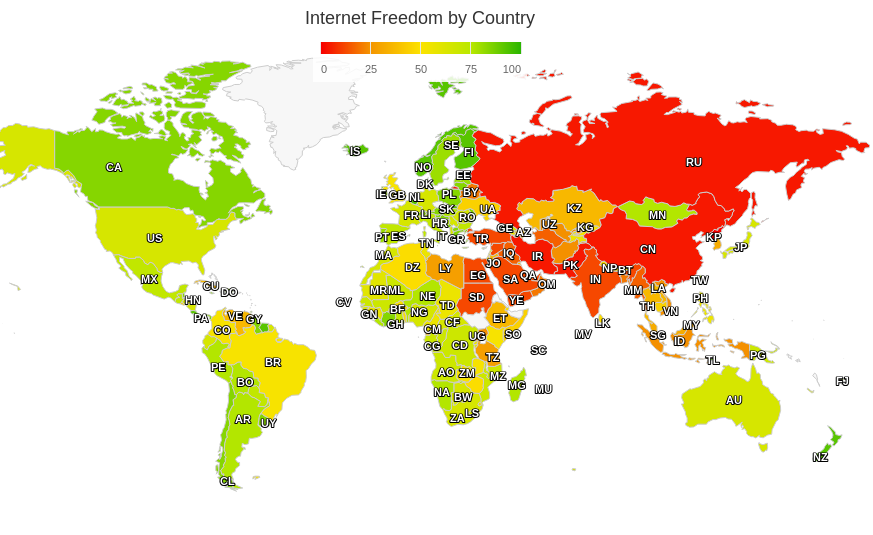
The study “Mapped: Internet Freedom by Country in 2026” covered 171 countries and used a 100-point scale (where 100 represents absolute freedom and 0 represents total censorship). To calculate the rating, analysts used aggregated data from technical platforms (such as OONI Explorer, which records resource blocking by providers), Freedom House reports, government notices, court decisions, and regulatory acts. The key criteria for the assessment were: the ability of citizens to freely access political and public content; the freedom to use social networks; and the presence of censorship and blocking of circumvention tools, such as VPN services.


