
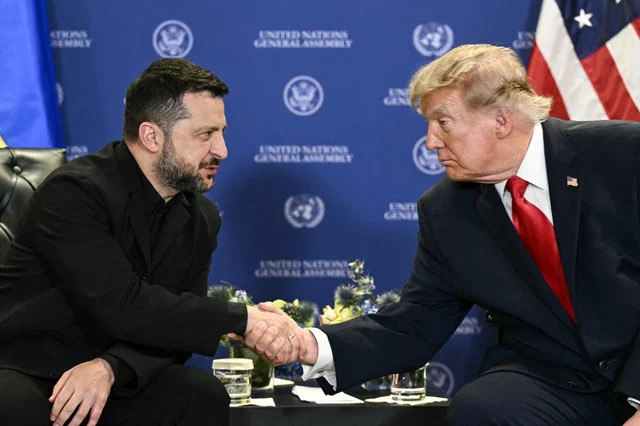
Ukrainian President Volodymyr Zelensky announced on September 25 that U.S. President Donald Trump has made a definitive decision to grant Ukraine licenses for the production of Patriot missiles, a critical component of the country’s air defense strategy.
During a recent meeting in New York, Zelensky revealed that Trump communicated this decision, stating, “Yes, I have made the final decision. Ukraine will receive the licenses to produce Patriot missiles.” However, Zelensky did not clarify whether this decision pertains to the PAC-2 or PAC-3 interceptor systems.
The PAC-2 systems are manufactured in the United States and under license in Germany, with some units expected to be delivered to Ukraine starting in 2027. In contrast, the more advanced PAC-3 systems are exclusively produced in the U.S. and Japan.
Despite the announcement, the U.S. State Department indicated on September 23 that discussions regarding the licenses were ongoing, and a final decision had yet to be reached. This follows a previous commitment made by Trump during a NATO summit in Ankara on July 8, where he stated that the U.S. would authorize Ukraine to manufacture Patriot air-defense systems.
Trump had initially expressed confidence in Ukraine’s ability to produce the systems swiftly, saying, “We’ll give them the right to make Patriots. We’ll show them how to do it.” However, he later retracted this commitment, emphasizing the need for caution in sharing sensitive military technology.
Ukraine has been actively seeking permission to produce Patriot interceptors domestically, as the system remains one of the few capable of intercepting Russian ballistic missiles. Reports indicated that shortages in July allowed a significant number of these missiles to evade interception.
In light of recent developments, Zelensky announced new Patriot packages and deliveries, claiming that Ukraine has improved its ballistic missile interception rate to 60 percent during a recent overnight strike, although details on how this was achieved were not disclosed.


