
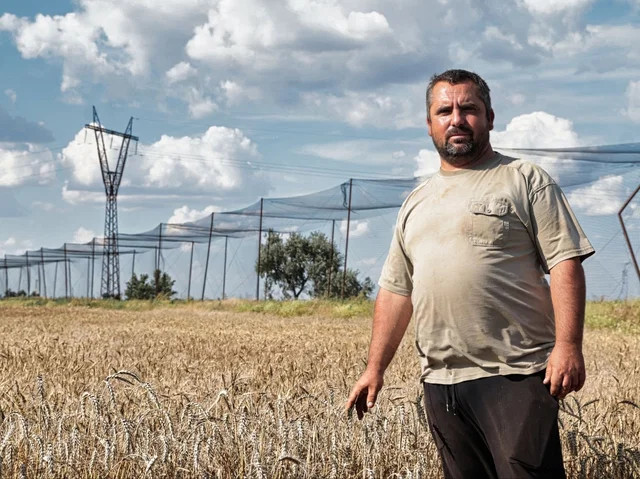
Ukrainian farmers in the Kherson region are grappling with an unprecedented crisis as Russian attacks have severely disrupted Black Sea export routes, leading to plummeting local grain prices. In Posad-Pokrovske, farmers Vyacheslav Dolholutskyi and Fedor Shpak are working their fields under the constant threat of drone strikes, supplementing their income through irrigation jobs as they struggle to sell their harvests. With wheat prices halved and no compensation in sight, they face an existential question: can small farming—and the villages it sustains—survive?
The Kherson region, marked by relentless shelling and anti-drone nets lining the roads, illustrates the stark divide between the international value of grain and the meager earnings for local farmers. This situation threatens not only individual livelihoods but also the very fabric of rural communities and the future of the next generation.
As one travels south of Kyiv toward the Black Sea, expansive farmlands of wheat, barley, and sunflowers unfold along the lightly traveled highway to Odesa. The ongoing watermelon harvest highlights the agricultural potential of the region, which supplies markets far beyond Ukraine’s borders.
Farming Under Fire
In Posad-Pokrovske, a tractor plows a field beside narrow roads, a reminder of the area’s tumultuous past where Russian troops once occupied the land. Vyacheslav Dolholutskyi, a farmer with a weathered face and broad hands, operates his tractor while keeping an eye on the skies. “You have to focus on the machinery; there’s no time to think about what’s flying above you,” he explains.
Farming approximately 100 hectares, Vyacheslav combines his agricultural work with a government job maintaining irrigation canals, providing him with a crucial income. However, the threat of drone strikes looms large, with drone detectors issued to canal workers serving as a grim reminder of the dangers they face. “If you see yourself on the drone’s camera feed, you have 30 or 40 seconds to jump out of the tractor and hide,” he recounts, highlighting the precariousness of farming in such conditions.
Struggles of the Harvest
As the war escalated in February 2022, Vyacheslav’s preparations for planting were abruptly halted. After fleeing to safety, he returned to find his village devastated, lacking basic utilities. Despite the challenges, he resumed farming, only to face a new crisis: the inability to sell his grain. “We managed to grow it, preserve it, harvest it, and now there is nowhere to sell it,” he laments.
In just two weeks, the price offered for wheat plummeted from $150-$160 per metric ton to around $90. Barley prices followed suit, reflecting a stark contrast to the higher prices available at export terminals. With limited storage options and no means to wait for better prices, many farmers are left with their harvests unsold.
Export Challenges
Access to Ukraine’s Black Sea ports has deteriorated significantly due to ongoing Russian attacks, which have cut grain-export capacity by a third. Farmers like Vyacheslav are caught in a bottleneck; while they may have buyers, the logistics of transporting grain remain fraught with danger. “Ships are afraid to enter; people are killed, ships are damaged,” he explains.
With most of Ukraine’s grain exports historically moving through seaports, the loss of maritime trade has far-reaching implications. Proposed alternative routes, such as rail through Moldova to Romania, could only carry a fraction of the original export volume, leaving farmers in a precarious position.
The Breadbasket Paradox
The repercussions of the export crisis extend beyond Ukraine, impacting countries that rely on its grain, particularly in Africa. As international markets react to disruptions, prices rise even as local farmers struggle to make ends meet. For Vyacheslav, his irrigation salary provides some stability, but he worries about the future of his farm and his family’s livelihood.
As he prepares for the next planting season, Vyacheslav faces uncertainty. Without sufficient income from the harvest to invest in fuel and fertilizer, the sustainability of his farming operation is in jeopardy. “Honestly, I don’t even know if farming can still provide a living,” he admits.
Community Resilience
In a region where agriculture is the backbone of the community, the challenges faced by farmers threaten not only their livelihoods but also the social fabric of their villages. Mutual aid becomes essential; neighbors share resources and labor, reinforcing the bonds that hold these communities together. “If we don’t have small farmers, there will be no village,” Vyacheslav asserts.
As the sun sets over the fields of Kherson, the reality remains stark: grain still stands unharvested, waiting for a future that feels increasingly uncertain. The ongoing conflict continues to cast a long shadow over the agricultural heartland of Ukraine, leaving farmers like Vyacheslav and Fedor to navigate a landscape fraught with peril and unpredictability.


